Wednesday, October 1, 2014

The Ultimate Guide To Google Webmaster Tools

google webmaster toolsWARNING:  If you are not monitoring Google Webmaster Tools, this is damaging to your business!


Do you know how essential it is to have Google Webmaster Tools installed?


When Google crawls through your site, it produces a report and gives it to you for free.  This report is available through Google Webmaster Tools and you can find out what Google likes and doesn’t like about your website.


Wouldn’t you like to know this information?


In this guide we go step-by-step through all you need to know about Google Webmaster Tools.


Why should you install Google Webmaster Tools?


Here are five good reasons to install Google Webmaster Tools:


1.  It shows you which keywords are driving traffic to your website.  Imagine if you saw that you were getting 1,000 visitors from a particular set of keywords and you had no blog post based on that set of keywords.  In this case, you could write a blog post specifically on those keywords and get a ton more traffic.


2. Imagine if Google took a look at your site and found that there were lots of dodgy links coming in to your site, wouldn’t you like to know that Google has identified a problem?


3.  When Google is indexing your site, it checks out your meta title (a one-line description of your page) and your meta description (a more detailed description).  If Google finds that you have duplicates then it’s harder to index the content correctly.  Wouldn’t you like to know if this is the case?


4.  Every site should have a sitemap, which describes all the content on your site and tells Google how often to index it.  If Google has problems with this sitemap, wouldn’t you like to know about it?


5.  Is your content strategy working?  If you are writing great content, the amount of your content that appears in search results should be going up all the time.  Wouldn’t you like to know this?


How do you install Google Webmaster Tools?


You will need a Google account, which you probably have already.  Once you have an account, go to to the Google Webmaster Tools set-up page  and click ‘add site’.


Add site Google webmaster

Add your site to Google Webmaster Tools


You will need to verify that you are the owner of the site.  Google gives you a few options to prove that you own your website:


a) Wherever you have registered your domain, you can add some information to the configuration that shows you that you own the domain.


b) Upload a HTML file.


c) Link it to your Google Analytics account.


d) Add some information to your home page.


e) Link it to your Google Tag Manager account.


Once your site is ready, you are up and running.


So, let’s step through all the sections of Google Webmaster Tools.


Site Dashboard


The site dashboard gives you an initial overview of the health of your website.  This is a summary and, when we go through the menu items, you can see that more details are provided for each section.


It contains three sections:


Current status


This is the first image you’ll see on the list.  You immediately want to see three green ticks:


DNS – When Google looks up your site, it needs to connect with a DNS (domain name server), which tells Google where to go to find your website.  If you see any errors on the DNS, that may be because Google has a problem accessing your DNS server.  It could be that it can’t connect with it at all or that there is a delay.  Either way, if you don’t see a green light, then you need to contact your hosting provider.


Server connectivity – If Google gets past your DNS but can’t then connect with your server, that’s another issue.  You don’t want your site to be down and you don’t want a super-slow website.  Get on to your hosting company, upgrade your hosting or move to another hosting provider if this happens regularly.


Robots.txt fetch – Normally, every site has a robots.txt file.  This gives Google some instructions on what to index and not index on your site.  It should also have information for Google about your sitemap (see later explanation).  It’s not essential that you have one but it is advisable.


For example,  here are two typical lines in a robots.txt:


  • Disallow: /wp-includes/ – This means don’t index anything in this directory

  • Sitemap: http://www.razorsocial.com/post-sitemap.xml – Here is the sitemap, i.e. you’re telling Google where it is.

So, it’s important that Google can access it correctly.  There could be areas of your website you don’t want indexing at all, and there could be one or more sitemaps you want to tell Google about.


Dashboard crawl errors

A snapshot of problems


Underneath this, you will see any errors that Google has found.  There are generally some errors displayed here and some are not of concern, but you do need to investigate them.  Here’s an explanation of each section:


  • Server error – If Google can’t access any URLs, you’ll see an error here.

  • Not found – This means that your server returned a 404 error, which means the page is not there any more.

  • Soft – A 404 error is returned when a page is not found – instead, you could assign a ‘200’ error and, instead of this page, send the home page to the person browsing.  However, Google does not like this so it’s not recommended.

  • Not followed – This is where Google can access your page but can’t read your content. This is an issue for your developer to resolve.

  • Other – If Google finds other issues that don’t fit into the categories above, they will list them here.

‘Not found’ errors


This is where you will generally have some issues listed, but a lot of the ‘not found’ errors could be valid.  Here are some things to consider:


  • Deleted pages – You may have created a page and then deleted it when you were finished with it.  If Google hasn’t updated the index yet, it will still attempt to access that page and return an error.  This should correct itself.

  • Pages that shouldn’t be indexed – Maybe there’s a page that Google has indexed when it shouldn’t have.  You need to check your sitemap to see if it’s in there, and you may need to update your robots.txt to make sure Google doesn’t have access to the directory where the page is.

  • The page is gone – Maybe it’s a genuine problem where the page has been removed accidentally, in which case it’s time to retrieve the file from your backups.

  • Linking to something invalid – Google finds a page and then follows links on that page.  If your links are broken then that’s an issue.  One thing you should definitely do on a regular basis is check and fix any broken links.  The best tool for doing this is Broken Link Check, which will tell you which links are broken.  If people click on links that go nowhere that creates a poor user experience, so it’s good to do this check on a regular basis.

Note: 404s don’t affect your site’s rankings but it’s still good to clean them up.


You can also go through each broken link, one by one, in Google Webmaster Tools.  You click on the broken link, select the ‘Linked from’ section, and this will show you the page that links to the broken link.


Link not found

Find out which page links to this


Site Messages


This is where Google gives you information about any problems it finds on your site.  Ideally you don’t want to see anything in this section.  But you could see messages related to:


a) Your site has been hacked


If Google thinks your site was hacked, you’ll see a warning.  The first thing you need to do is talk to your development team and/or hosting team to do an analysis and resolve this as soon as possible. Google is not going to send you a lot of traffic (if any) if it thinks your site has been hacked.


b) Unnatural links pointing to your site


It’s bad if you link out to dodgy sites, but it’s also bad if you are getting links back to your site that look unnatural from Google’s point of view.  Unnatural links could be a high volume of links from sites that Google has identified as spammy.


It’s important to be notified of these messages.  Select the ‘preferences’ option at the top right of your screen and make sure notifications are switched on.


Site preferences

You really want to get an email if there are issues!


Under the ‘type’ section, you can specify whether you want to notified of all messages, or just the top issues.


Search Appearance


The default screen displayed is the dashboard screen that we explained earlier on in this document.  This shows three sections – crawl errors, search queries and sitemaps.


There are also some additional menu options:


Structured Data


Structured data is adding additional information to your web page to describe what is on it.  You use a specific format, available on Schema.org, or you can use Microdata, RDF or Microformats.  They all do pretty much the same thing.


Why would you use structured data?  


Here’s an example:


I searched for ladies’ shoes on Google.  I don’t normally search for ladies’ shoes, but I thought it would be a good example!


You can see that there are star ratings added to this listing.  This makes the listing stand out on Google and, with a high rating, the click-through rate will be higher.  This is microdata.


Example microdata

Here is an example of additional information provided in search results


This section tells you if you have any errors with your microdata that need correcting.


Data Highlighter


After reading the previous section, you may be thinking that structured data is a bit complicated.  It is, but not for a developer.  However, the data highlighter is functionality that is provided by Google to make it easier to add structured data to your content.


This is how you do it:


Enter the web address of your site and specify what type of page it is.  For example, it is a page all about book reviews.


In our example, we picked articles.  When you use highlighter, you can decide if you want Google to tag just this page with the additional information, or if you want Google to tag all similar pages.  This saves you performing the same process for hundreds or thousands of similar pages!


Data highlighter

Data highlighter configuration


In the following example, I have highlighted the title of the post and then selected ‘Title’.


Highlighting parts

Highlight relevant sections and tag


As you are highlighting sections you’ll see that, over on the right-hand side, Google displays what you are tagging.  In this example, I highlighted the blog title and an image within the blog post.


Data highlighter

As you highlight and tag items, Google will display them to the right


Your best option for adding this structured data to your content is to code it within your pages (e.g. using Schema.org). Using the highlighter is not as good, because this is specific to Google only.  If you don’t add the code then other search engines or products outside of Google will not see this structured data.


However, Google is probably your number one target and, if you can’t afford to get a developer to do it and you want it done quickly, this is a good way of doing it.  For example, imagine you had a website with 1,000 pages and each page covered a product and had reviews of it.  You might want to use the highlighter as a quick way of telling Google about the reviews.


HTML Improvements


This is a useful area because it displays any issues with your content that would affect your ranking, so resolving all issues is worth your while.  Here are the sections it covers:


  • Meta Descriptions – When you search Google, the first line you see in the search results is the ‘meta title’, and the next couple of lines are the ‘meta description’.  It’s best to keep this content between 150 and 160 characters. If you have descriptions that are too long, they won’t be displayed by Google and, if they are too short, there may not be enough information for the browser to decide if the article is relevant to them or not.  It’s also not good if the meta descriptions are exactly the same for two different articles.  So, look at the errors provided by Google and resolve them!

  • Meta titles – When Google is indexing your content, it looks at a tag called a title tag.  Google will normally display 50 to 60 characters of a title tag; it’s not an exact number of letters because, if you have lots of narrow letters in your title, more characters will fit in the same space!  As the title tags are used as part of Google’s indexing algorithm, you don’t want to mess with them.  Make sure there are no duplicates, that they are the right length, that they are not too long etc.

  • Non-indexable content – If Google finds content that it can’t index (and you didn’t specifically ask Google to not index it), you will see a list in this section.


HTML Improvements

Identify and resolve any issues displayed


Sitelinks


If Google views your site as an authoritative site then, instead of just showing a one-line listing for your website, it will show some links to high-authority pages on your site.  This is great, because your listing will appear a lot bigger so it will look more important and people will be able to click directly onto an article of interest.


Site links

These links are automatically retrieved and displayed by Google


You cannot ask Google to create sitelinks for you if they are not already displayed; Google makes that decision.  You also cannot ask Google to add on a sitelink to a page you think is important.  The only thing you can do is demote a link and remove it from the listing.


Demote a link

Remove a sitelink that you do not want


Search Traffic


This provides a wealth of information related to search on your site.


Search queries


You can view this in ‘top queries’ or ‘top pages’.


Top queries


This shows you a list of the keywords that are driving you the most traffic.  Here’s how it looks:


Search queries

View the top queries for your site


Here is an explanation of each of the columns:


  • Query – The keywords used to find your site.

  • Impressions – This is the number of times a web page on your site was displayed as a result of your keyword search.  If someone searches, and you are on page 2 for that search, it is counted as an impression when someone goes to page 2.

  • Clicks – This is the number of times someone clicks on your link in the search results.

  • CTR – This is the click-through rate, which is the number of impressions divided by the number of clicks.

  • Avg. Position – For an impression, what was the average position you appeared in search results?

What to do with this information


Here are some things to consider:


1. Are there any search queries that are not relevant to your site?  Sometimes, you end up ranking for content that is not relevant at all to your business.  Imagine if you had a website about gardening and you wrote a post about ‘Rihanna’s habits for gardening’.  If you are ranking for ‘Rihanna’s habits’, that is not going to be relevant.  It’s ok if there are a couple of keywords like this that don’t make sense, but you certainly don’t want a load of them.


You want Google to understand what your site is about.  If you are ranking for invalid keywords, find out the offending page and start changing the content so you are more likely to rank for relevant keywords.


2. Is your click-through rate low for relevant content? Imagine if you had really good content that was found regularly but the click-through rate was low.  To improve the click-through rate, you may update the title and description so it’s more relevant and also more enticing.


3. Are you ranking for keywords without any focussed articles for those keywords?  You might find that you are ranking for keywords you never tried to rank for, and maybe your average position is on page 2 or further down.  If you’re already getting traffic for keywords on page 2 and you haven’t targeted these keywords, it’s highly likely that you will get more traffic if you write an article really focussed on those words or phrases.


4. Are you getting clicks but your article is not appearing on page 1?  If you have an article focussed on particular keyword terms and you’re getting traffic, but your average position is on page 2 or lower, then you may want to optimize this post further.  This means reviewing and updating the content, building links from other pages on your site or building links from external authority sites.


Tip: If I had an article on ‘Facebook Contests’ and I wanted to find other articles on my site I could link to, I’d go to Google and type ‘Facebook contests site:www.razorsocial.com’.


As part of the top pages, you can also view a graph of queries, impressions and clicks based on those impressions over a specific time period.    Of course, ideally you want to see this going up all the time.


But the most important figure is clicks.  Impressions are pointless unless people are clicking on your content.


Query Graph

View the queries over a period


Top Pages


Instead of viewing by top keywords, you can also view by top pages.  There is an option here to view the different search results, clicks etc. for each page, based on the previous period.  It is very useful to look at this.


In the example below, we have highlighted where we update this setting.


search web pages

View a comparison over the previous period


If you notice over on the left hand side of the image above you see a triangle symbol.  Click on this and Google will show you all the search queries used to send traffic to that blog post.  This is really interesting information!


Links to your site


This shows you the links from external sites to your site.  You can drill down and pick pages on your website to view all the links from those pages.  Here’s an example:


links to your site

View a list of links by pages


It’s useful, every so often, to do some link analysis.  You can export all the links and view them in an Excel spreadsheet where you can do further analysis.  One area to focus on is to identify who is linking to which blog posts, and also look at which posts get the most links.  Why waste time on content that people aren’t linking to?  If they are not linking to your content then it’s unlikely you will rank for the content.


You’ll probably find that the articles with the highest amount of links are the the long, detailed articles, infographics and group posts!


Although you can do some analysis here, my preferred tool is Ahrefs, which gives me more details related to the links e.g. the value of each link.


Internal Links


There are internal links where you are linking to content on your site.  I don’t find this section particularly useful because menus appear on every page so it looks like your posts are linking to every menu item on every page.  This means you are shown tons of links so it’s harder to find out which ones are relevant.


What is important is that you have an internal linking strategy to link relevant posts together.


As mentioned earlier, on a tip to find posts worth linking to, go to Google and type the keywords of the post you want to link to and then add your domain name using the ‘site’ command as follows:


“Facebook applications” site: www.razorsocial.com


You’re looking for incidences of the term ‘Facebook applications’ being mentioned in any posts within razorsocial.com, these posts are relevant so it’s a good place to link to your post.


Remember, you can link old posts to new posts and new posts to old ones!


Manual Actions


When you arrive on this page, you want to see a nice message saying ‘no manual actions found’.


Manual actions are penalties imposed by Google on your site because they have found something on your site they don’t like.  Manual actions can be site-wide matches that affect your whole site, or partial matches that affect parts of your site.


When you see that an action has been applied, you’ll see the reason for the action and how much of the site has been affected.


The types of manual actions could be:


  • Unnatural links to and from your site – Make sure you remove these links. If external sites that Google doesn’t like are linking to you, reach out and ask them to remove the link.

  • Hacked site – Get on to your hosting provider and/or development team to resolve this ASAP.

  • User-generated spam – Spam content on your site.  Get your development team to do an analysis and remove it.

  • Content with little or no added value – Remove this content and start focussing on higher quality content.  You might have thousands of pages with very little content on each page and it looks like you just created the pages to rank for the content.

  • Pure spam – Get rid of any pure spam content.

  • Spammy freehosts – A significant percentage of pages on your site are spammy, remove pages.

  • Spammy structured markup – If you’ve added data to describe your content but Google thinks it looks spammy, you will either have to fix it or remove it.

  • Hidden text or keyword stuffing – This was a bad practice years ago where extra content was added to rank for keywords.  Remove this asap!

  • Cloaking or sneaky redirects – You are showing different pages to Google than what you show to your website visitors.  Change this asap!

When there are manual actions taken on your site and you resolve the issue, you can send in a request to Google to get the issue sorted.  For example, if your site was hacked, once you resolve this Google will restore your previous listings.


International Targeting


There are two options here:


a) Language targeting


If you are targeting people in different countries, you will need to point people to a page with the relevant language.  In this section, any language targeting will be displayed.  Google will look at your website pages and try to find a line like this:


<link rel=”alternate” hreflang=”x” href=”alternateURL“>


This will tell Google if you are doing language targeting.


b) Country targeting


In Ireland, the domain extension is .ie, so if Razorsocial was focussed only on Ireland, we would be razorsocial.ie.  That is a country-specific extension and Google automatically assumes you are targeting Irish visitors.


But, if you have a non-country-specific domain like .com or .org, you should tell Google which the most important country for you for ranking is.


International targeting

Specify the specific country you want to target


Google Index


This gives you information related to the indexing of content by Google.


Index Status


This will show you the number of pages on your website that are indexed by Google, as well as the ones that are blocked from being indexed.


Ideally, you want to see the graph going up as you write more content.  Google never indexes 100% of your content but you’re looking for a number that is very close to the total number of pages on your site.


If you go to the advanced section, you can also see the total number of pages that have been blocked.


Index Status

View a summary of the index status


Robots.txt is a text file that is normally found at the root of your website (e.g. www.razorsocial.com/go).  In this file, you give Google bots (software that comes to your website to index it) specific restrictions and information about what to index and what not to index.  There may be a membership site you don’t want indexed, specific parts of your WordPress install, privates web pages etc.


If you think there are too many pages being blocked, you need to investigate your robots.txt to make sure it’s blocking the right content.


If you feel that not enough pages are being indexed, you need to start looking at your sitemap file to make sure you are telling Google to index all the right content.


Content Keywords


This is where Google does an analysis of your website to see which words are appearing most frequently.  You want to make sure that these keywords are relevant to your site.  If you find that spammy keywords are appearing here, you can click on the keyword to find out which articles are using these spammy keywords and then you can remove them.


Content Keywords

See what Google thinks your site is about


Remove URLs


If there is a URL that Google is indexing, you can submit a request for Google to remove that URL.


But be careful.  Google specifically say that this should only be used in emergency situations where something like confidential information has been exposed.  It clearly states that if you use this for other purposes it may affect your site.


So, don’t use it if it’s a page that is giving a 404 error (page not found), or just any page that shouldn’t be indexed but is not doing any harm.


Really, you should only use this in an absolute emergency.  Here are Google guidelines -> Click here.


However, before you do this you need to try and get rid of it yourself:  You can make sure your sitemap is rebuilt so that it’s not longer in the sitemap.  If it’s a directory with only a few pages, you could block Google’s bot from indexing the content by adding a relevant line in the robots.txt file.


Crawl


Does it feel creepy that Google crawls through your website?  It is creepy, but I welcome it!


Google sends out its bot to look for new content, but it’s friendly enough to tell if you if it finds any problems, which it breaks down by desktop, smartphone and feature phone.


In the list below, there are a few errors worth investigating and resolving.


URL Errors

Find and resolve any crawl errors


For example, the first error is a server error and this is related to a page not found.  I clicked on the link and, on the page below, I can ‘fetch as Google’.  The page was returned fine so I just marked it as fixed.


Server error details

Mark the issue as fixed if it’s no longer an issue


Crawl Stats


The crawl stats show you the number of pages that are crawled per day, the total content downloaded each day (to analyze for indexing) and the time spent crawling the pages.


Ideally, you want the number of pages crawled to be going up as you add more content.  If it isn’t, then you need to start investigating this (clue: start with the sitemap).


If the time it takes to crawl your site is going up a lot, that’s a cause for concern.  Google wants a fast website, so you need to make sure it’s not taking too much time for Google to download content.


For example, your server could be slow at certain times of day and this could be when Google is crawling it.  This may mean you need to change servers.


Fetch as Google


This allows you to ‘fetch’ your content and see it as Google sees it.  If Google has problems accessing your content then you will need to resolve this.


You can fetch it as code or fetch with it fully rendered (i.e. displayed fully, not in code).


Robots.txt Tester


If you want to see if any page is blocked when it shouldn’t be, in your robots.txt file, you can enter the web address to test it out.


Sitemaps


The sitemap is where you tell Google about all the content you have on your website and how frequently you want it to be indexed.  There’s no point in getting Google to index content every day if it doesn’t change that often.


You will notice that you’ll never get everything you submit indexed, but if the number of submitted pages versus indexed pages is very close in number then you don’t have a lot to worry about.


post sitemap after

Very close to 100% indexing


If you don’t have a sitemap, there are various tools that will help you create one.  For example, WordPress SEO by Yoast creates and updates the sitemaps required (and you can have multiple sitemaps for different areas of your site).


URL Parameters


Sometimes, you can have the same content on your website but it is tagged differently at the end of the page name.  Google will normally figure out whether it’s the same content or not, but if it can’t work it out you may need to provide it with some help.


Be very careful with this section – you’re probably better avoiding it because it’s super techie!


Security Issues


If there are any security-related issues found by Google, they will be listed here.  Obviously, you will need to resolve any security issues as soon as possible.


Summary


Google Webmaster Tools is an extremely important item in your tool box.  Google tells you of any issues it finds when it crawls your website, and because Google probably sends you the most traffic, you need to pay attention.


Have you installed Google Webmaster Tools yet?


Do you look at it regularly?


Will you install it after reading this post?


Thanks for reading!


Ian


Map image by Shutterstock


The post The Ultimate Guide To Google Webmaster Tools appeared first on RazorSocial and was written by Ian Cleary


The Ultimate Guide To Google Webmaster Tools

Who Is More Active on Social Media? Men or Women?


Have you ever wondered who uses social media more often: men or women? It may not seem like an important stat, but if the majority of your customers are of one specific gender, it will affect which social sites you’ll need to target.


In order to save you time, I’ve analyzed all the popular social sites to see who uses them more frequently. This way you won’t waste your time marketing your business on a social site that isn’t used by your target audience.


Here’s what I learned.


Click on the image below to see a larger view:


Who is more active on social media Men or Women


Click here to view an enlarged version of this infographic.


Conclusion


If you are looking to target women, you should focus your efforts on Facebook, Instagram, Twitter, and Pinterest. If you are targeting men, focus your energy on LinkedIn, Google Plus, and YouTube.


Most of my revenue comes from men, and LinkedIn is my highest converting channel. I’ve also tried other social media channels. I tried Pinterest, for example, but I was unsuccessful at generating revenue from it.


What are your favorite social channels and why?


Embed This Image On Your Site (copy code below):


Powered By WizardRSS.com | Full Text RSS Feed | Amazon WordPress | rfid blocking wallet sleeves


Who Is More Active on Social Media? Men or Women?

Google Organic Click-Through Rates in 2014

Posted by Philip_Petrescu


We’ve all been there. Trying to improve our organic rankings so we can get more traffic from the search engines. And every time we do that, we are left with some big questions in our minds:


  • How much traffic would I actually get if I rank on the first page?

  • Is it worth my time trying to rank above the fold?

  • How much more traffic will I get if I rank first in the organic results?

I’ve been there, too. I felt overwhelmed and frustrated every time I had finally reached a number one organic ranking in Google only to find out that the traffic coming from the search engine was not making the big difference I was expecting.


So I started searching for a way to find out how much organic traffic I could get for ranking on the top positions in Google.


But I faced a big challenge. These days, with “not provided” being almost 100%, it’s very hard to measure how many people reach your website searching for a certain keyword.


So I turned to the best source that I could get this data from, Google Webmaster Tools, which allowed me to see how many people click on my website when searching for the keywords I am interested in. This saved me a lot of time and allowed me to make better choices in the future with the keywords I was targeting.


Sounds like something you would be interested in?


Read on to find out more about how my initial findings turned out into a full fledged organic CTR study and how you can use this data to make better and more informed decisions in the future.


TL;DR: This will be a long post, so for those of you who are anxious to see the results of this study, scroll down to the CTR Study section below. Alternatively, you can download the complete study in PDF format or check out the free Google CTR History tool we have built to aid with this study.


Previous CTR studies


This is not the first study of its kind. There have been a number of studies in the past that have tried to find out the CTR for organic results. It all started when AOL released more than 20 million search queries made by more than a half-million users in 2006.


A number of studies followed after that, including those from Enquiro (now Mediative) in 2007 and later by Chitika and Optify in 2010. More recent studies have been performed by Slingshot in 2011 and then Chitika and Catalyst in 2013 respectively.


Here is a comparison of the Click Through Rate for each study: D6Mn7Te0QWruYBrK0hupxs7us0qfL7rZ109_hW2O


It’s important to emphasize the major differences in the methodologies applied for each study, as they are the main ingredients responsible for the dissimilarity of the results:


l_ErtCTdaKQRC9SiERMy-bKy_FgpHUmDVD99Xx1T


It’s worth noting that the studies conducted by Mediative (former Enquiro) and Chitika, have been executed through unique methods that cannot be truly compared to any of the other studies. Mediative’s study relies on survey data and eye-tracking research, while Chitika’s studies are based on ad impressions served within their network.


Also relevant for a comparison is how CTR is defined for the other three studies previously conducted:


  • Optify defines CTR as “the percentage of users that clicked on each position, given that a user clicks on a top 20 organic ranking.” Their study makes the assumption that all searches result in a top 20 organic click.

  • In the Slingshot SEO study, CTR is calculated as “total visits (via Google Analytics) divided by total searches (via Google AdWords Keyword Tool) for a given keyword over a stable period.”

  • For the Catalyst study, CTR is defined as “the percentage of impressions that resulted in a click for a website (via Google Webmaster Tools).”

Our study retrieves the CTR data from  Google Webmaster Tools so comparing it with the Catalyst study would be the most accurate.


So why a new study?


First of all, the Google search results have evolved significantly since these studies were performed. Besides having a fresh set of data, we also wanted to make this study unique.


  • Unique
    This study is unique because we have segmented the queries to be able to see how the CTR is affected by different types of searches. For example, we have segmented the keywords by category (industry), search intent, number of words (long tail) and whether the keywords are part of a branded search or not.

    Another important section of this study is trying to find out what impact some features that appear in the SERP (such as ads) have on the organic results CTR. 


  • Accurate
    To make sure that we get relevant and accurate results, this study is based on search data coming from Google Webmaster Tools for 465.000 keywords and 5.000 websites.

  • Transparent
    This study was intended to be as transparent as possible. Thus, we have included our step-by-step process below so you can see how we arrived at our results. 

    More than that, we also decided to give away the entire set of data so you can do your own research. To protect our clients, the actual keywords have been anonymized in the data set. 


  • Up to date
    As we have seen with previous studies, the organic CTR changes in time due to various factors. It can be affected by the holiday season, or by more features that are constantly being added in the SERPs.

    This is why we decided to transform the initial study into a free tool that anyone can use to segment the data and watch how the CTR changes in time.


Read on to see how different types of search results influence users’ behavior and what role the user intent has in determining the distribution of clicks.


Our methodology


Here’s how we obtained this data in case you want to do a similar analysis for your own websites:


  1. Download average search query data from GWT

    The initial data was obtained from Google Webmaster Tools (GWT) with the default filter: Web. This includes only traffic coming from non mobile devices. Our data set includes only keywords that have at least 50 impressions per month.

    We then changed this filter to Mobile and downloaded the table again to get CTR data for mobile devices.


    The Avg. position column from GWT displays an average of all ranking positions that this keyword has appeared in. This data was used to build the section of the charts.


    Y4saunNahkQSZAQKVVkr8EHpmwVVEBq_d9QhFY92 


  2. Download exact search query data from GWT

    In GWT, when you click on a keyword in the Search Queries table, you will be sent to a report called Query Details. This report provides the CTR for each exact ranking position for that keyword.

    For example we can see here that every time this keyword was ranked first in the search results, the CTR was 56%. That’s because 2,947 people searched for it (Impressions) but only 1,644 people actually clicked on it (Clicks). xdgGKSBCzA2OiYtKWcVZ597s-1ucSXMg22dNMU_o 


  3. Exclude from exact data the queries with less than 500 impressions per month

    This was done to ensure that we get accurate CTR results. A filter was also applied to include only the keywords that had at least 10 impressions per month for each exact position they appeared in.


  4. Categorise queries based on brand, search intent and number of words

    We wanted to see how the CTR changes for searches that contain branded keywords. Most brands rank first for their brand keywords and it is believed that people tend to click on that first result.


    For this study we have defined brand searches as searches that contain the entire domain name of the website in the query.


    The same thing happens when people include a search intent in their query. It is believed that people act differently when they are interested to buy something as opposed to looking for information about something or when comparing different things.


    How can we figure this out? We look for certain words in the search queries, trying to guess what the intent was for that search.


    There are three types of search intents that were included in this study:


    Informational
    This includes searches that contain words like: what, when, where, how, who, restaurant, hotel, flight, definition, define, review, news, weather, time, phone.


    Commercial
    This includes searches that contain words like: buy, purchase, order, shop, coupon, cheap, cheapest, expensive, pricing.


    Location
    This includes searches that contain words like: near, nearby, from, directions, how long to, how far away from, how fast, train station, airport, ferry, route, highway, toll, plane tickets, flights, maps, driving directions.We have also tracked long tail queries (more than one word) separately to see how they affect the CTR.


  5. Find out if the SERP contains ads

    We matched the entire set of keywords from Google Webmaster Tools with the ones we track for each client in AWR Cloud. This way we were able to get more information about the features included in the SERP, such as the number of ads and their position and if any Universal features were included in the search results.


  6. Create graphs for easier data analysis

    We first used Excel to display this data in charts but in the end we ended up creating an in house tool because we realized that it would be interesting to see how the CTR changes over time.


Assumptions and limitations


The sample data set that was extracted from GWT belongs to our clients. Their businesses, although variate, may belong to certain industries that are different than the industry you are in. Therefore the results may not be the same for every business.


This study measures the CTR that was observed for a special time frame (within the month of July 2014). That means we cannot predict how the CTR changes for keywords that have higher volumes in different periods of the year.


In this study, we also made the assumption that the data collected from GWT with the above methodology is accurate.


The CTR study


This is the reference chart for the click-through rate (CTR) of organic desktop searches in Google for July, 2014.


Xez3QYwJG4xzZ9ep9iM7oODaMM4dzkbFqSJKGApu


11rZlDsf1tbgOHDy3XDFEbh-c9yTIqQgHGCwPT9a


It is important to mention that these numbers reflect the CTR across all the searches included in this study. They do not account for the user intent, the features that appear in the SERP, or whether the keywords used in the search included a brand name. These will be addressed later in the study when we segment the data.


On average, 71.33% of searches result in a page one organic click. Page two and three get only 5.59% of the clicks. On the first page alone, the first 5 results account for 67.60% of all the clicks and the results from 6 to 10 account for only 3.73%.


5edKFlyYEHnYWskGGfiM-iMxHxUN-_e_Iq2rS-6d


“These numbers serve as a useful reminder of the importance of organic rankings, and reconfirms the importance of the top few positions on Google. Although the first spot is still the most valuable for CTR, it seems to have become less so. I’d guess that part of the reason is that the increased use of ads, universal search results and Google’s own comparison and shopping results have reduced the prominence of top slot.”  Graham Charlton – Econsultancy


In case you wonder where the other 23.08% of the clicks are, here are some possible scenarios:


  • Some people may find the ads displayed above the organic results more relevant.

  • Some people may not find what they are looking for in the first 10 results so they click on results from the second or third page instead.

  • Others may not find what they are looking for at all so they refine the search adding more words to the query to be more explicit.

  • With Google providing more and more instant answers people may very well find the answer to what they are looking for in the displayed search results so there is no need for them to click on any of the results.


Mobile


Mobile traffic is getting bigger and bigger day by day. Here we can see the CTR for searches coming from mobile devices compared with the searches from desktop devices.


Given the fact that you can see fewer ranking results above the fold on mobile, people have assumed that the CTR would be higher for the first results on mobile devices. Let’s see if that is the case:


rc0l1Y-vhS6NCtnIR4pNegYAWp_HgkNVBGZUvUkS


Not only is the CTR slightly lower on the first page, but the CTR for mobile searches actually rises on the 2nd and 3rd page, which is opposite to what we would expect and see from mobile searches.


“I would’ve expected mobile to drop off much, much faster than desktop. These rates seem to imply that the first positions on a mobile results page are less significant than we thought. Does that mean people are scrolling more?”   Ian Lurie Portent


Branded vs. unbranded


One might assume that when users are making generic searches on Google, they end up making a brand selection from the results retrieved. They choose from the handful of options received, the source of information or provider to trust in for satisfying their need.


But what happens when  branded searches are made? If the users are clearly looking for information related to a specific brand, will they follow the same behavioural pattern as for generic searches?


YG_GkLNPYwuBuRBTNhhhNMla4Jzl_-buiMV-RrJw


For branded searches the first result is almost always associated with the brand’s website, which makes it the obvious choice for most users and very hard to miss. This would justify the big CTR difference between the first position and the rest of the SERP.


This big difference in CTR may also be affected by the fact that brand searches usually display a pack of 6 site links just below the first result, making it more prominent in the search results.


“People will seek click on a brand in the first position for a search on that brand way out of proportion to all other positions.”   Danny Sullivan – Search Engine Land


“The CTR data coming straight from Google suggests that we should be even more conservative when estimating potential search traffic. Most of our keyword research is going to revolve around non-branded terms. If you study the data, you’ll see a dramatic difference between CTR for the #1 position of branded vs. non-branded search. Our views of how many clicks you will get with an average position of 1 may be skewed because of this. But now with this segmentation data, I know I will be viewing traffic potential even more conservatively based upon CTR of only non-branded keywords.”   Dan Shure – Evolving SEO


Search intent


Most of us have some sort of intent when we search for something. We may need to find the location of a restaurant or a better price for that big TV we always wanted to get in the living room.


It is believed that people who search for keywords with high commercial intent (“buy 4k LCD TV”) are more likely to click on the first results than people who perform basic informational searches (“where is the nearest thai restaurant”).


Let’s see if search intent does indeed affect how people click on the results.


PtiCgS5rH6GyRqBzCulpGIHjI-zRi7aMchp26pDy


This chart reveals that people tend to click more on the first results when their search has a specific intent. So we wanted to dig deeper and see which of the search intents affect the CTR and how.


“Google uses a lot of context cues beyond the keyword so if I type ‘restaurant’ the intent isn’t there, until you realise it is midday and I’m on the street searching on my iPhone. This might explain the significant uptick in clicks on positions 1-3 for searches with intent.”  Tom Anthony – Distilled


The “Specific Intent” in the chart above is the set of all keywords found in the Informational, Commercial and Location sections and the “Other Intent” means all the other keywords.


The following chart compares these three search intents and how they affect the CTR:


HBwpbP__Rmd7CGhYdj2tsJy80vo3U6q0k_CE0IR3


Google is getting better and better at figuring out search intent. Nowadays, many of the search results contain instant answers so people no longer need to click on a website to find out what they’re looking for. The answer is already there.


Commercial intent searches usually trigger ads that have colorful pictures of the products we search. It’s usually a lot more tempting to click on these pictures than on the first organic results.


“Search results for commercial intent keywords usually contain more features (eg: pricing, ratings, shopping results) which might dilute the CTR across the page.”  Richard Baxter – Builtvisible


“It’s interesting that commercial intent searches have a lower organic CTR than informational searches. We’ve seen the opposite hold true for paid CTRs. This may be because commercial intent KWs are more likely to trigger ads, which lower the organic CTR.”   Mark Irvine – WordStream


Estimating organic traffic based on CTR


Remember the initial goal of this study? To find out how many organic visits one could receive for ranking in the top results on Google. We are now closer to reaching our goal.


By knowing the CTR for each position in the organic search, we can now calculate the organic traffic potential of a website. Depending on the ranking of a keyword and how many people click on that website, we can easily calculate how many people would reach that website from organic search.


Theoretically, by taking into account all these factors, one could easily estimate the amount of organic traffic. The formula is quite simple:


Traffic = Search Volume * CTR


But things get a little complicated when taking into account that each keyword is different.


As this study showed, searches for branded keywords have a higher CTR. Search intent also affects organic CTR significantly and long tail keyword searches show higher CTRs for first page listings.


Let’s see an example for an unbranded keyword with a volume of 1,000 searches per month where you rank first in the organic results with no ads above you:


1,000 x 24.8 / 100 = 248 (visits per month)


where 24.8 is the CTR for the 1st position for unbranded keywords.


Applying this formula for each keyword, enables you to estimate the amount of organic search traffic for any website.


Where can you get this study from?


This post contains only parts of the actual study. To find out how ads affect the CTR of organic results and more, download the complete Google Organic CTR Study in PDF format.


You will also get access to the entire data set that we used for this study if you want to do your own research.


Future developments of the study


We will be constantly adding new features to this study, such as more ways to segment the data or insights on how different features that may appear in the SERP affect the CTR. These new additions will be featured first in the free Google Organic CTR History tool, so make sure you check it out.


The first thing we want to tackle next is how the features that appear in the Universal results (such as news, videos, places, etc.) affect the CTR. We will then dig deeper to see how the CTR is affected by carousels, answer boxes and other knowledge graph features that appear in the SERP.


Your turn


Is there something in particular you would like to see in further updates of this study?
Post your comments below and let’s find out how we can improve this tool to benefit the entire community.


Sign up for The Moz Top 10, a semimonthly mailer updating you on the top ten hottest pieces of SEO news, tips, and rad links uncovered by the Moz team. Think of it as your exclusive digest of stuff you don’t have time to hunt down but want to read!


Google Organic Click-Through Rates in 2014

This App Will Tell You The BEST Time to Take Photos

shutterstock_170815868


Not being a morning person whatsoever and working full time in addition to blogging, I spend most of my weekdays fighting the rush hour crush on the subway, racing against light and time to get home for a quick 20-30 minute photo shoot to capture my personal style before the sun goes down. It’s never quite predictable as to how much time I may have left to shoot, and several times I’ve gone inside my apartment to drop my bags and grab my camera only to reemerge outside and glumly realize that I’ve lost my tiny window of good natural light. Ugh!


This past week, I tried the free Sunrise Sunset Lite App (available for Apple devices), which uses GPS to track your location and tell you the sunrise and sunset, along with when the dawn begins, and when dusk officially settles in.  If you are planning to take some photos outside in, say, five days from now, you can also scroll ahead or set the date to find out how much time you may have until the sun goes down. Through testing it out, it tends to be pretty accurate, capturing the right time or being within a minute or two the actual sunset.


Even though it may be obvious when the sun is starting to fade, I feel that it’s made me quite a bit more realistic about how much I can squeeze in post-work, and I have a better grip on consistently finding the best light for my photos.


I’m always skeptical to pay for an app unless I’m sure I will use it a lot, so if you love the free version, the standard edition (99 cents)  let’s so save your location and search others, helpful if you are planning an trip somewhere and plan to take photos there, while the Sunrise Sunset Pro ($1.99 ) is the upgrade I would put my money on, as it includes everything else mentioned, plus it shares the sun’s angle, tilt, position throughout the day via a compass so you can really pinpoint where it will be and when. There are other apps that do just this feature, and cost a lot more, so this one may be a great way to see if you find it to be helpful. Since there isn’t an app that can make the sun stick around longer or get me out of work earlier, I find the Sunrise Sunset one one to be the next best thing.


What apps have you found to be helpful for taking blog-related photos outdoors?


[Image credit: Shutterstock.com]


This App Will Tell You The BEST Time to Take Photos

4 Steps to Minimize the Risk of Owning a Home

roof repairsNot so long ago, in a not-so-distant land, owning a home was thought of as the safest “investment” around. Fast forward to the present day, and home ownership seems super scary to many people who can afford homes, and would like to own them, but are paralyzed by the fear of buying a lemon, or having a mortgage catastrophe.
Here are 4 simple steps to minimize the risk that you’ll become the main character in a homeownership horror story.
1. Stick with a fixed-rate mortgage. Recent data shows that adjustable rate mortgages, or ARMs, are increasingly popular, rising from 9 percent of the mortgage market in the fourth quarter of 2010 to 12 percent in the first quarter of this year. This might seem crazy to some, but in financially aggressive crowds, the Roofers lure of low, 3 percent(ish) interest rates on ARMs is enough to overcome any qualms. As well, today’s ARMs tend to have lower lifetime interest rate caps and require payment of principal, so they don’t adjust as violently as the subprime interest-only and option ARMs that contributed to the foreclosure crisis.
If the thought of your mortgage payment changing over time gives you the shakes, you don’t want to live in a state of interest rate obsession for the next few decades, or you simply crave the simplicity and predictability of knowing what your housing payment will be for the next 15, 20 or 30 years, then stick to
a fixed-rate mortgage. The rates are higher, but with a fixed-rate loan, the risk of scary payment changes are not only Roofers lower, they are non-existent.
2. Put – and keep – a home warranty in place. One of the most frightening things about going from renter to homeowner is the prospect of being solely responsible for the care and feeding of your home and all its systems and appliances. Responsibility for both the costs and the actual logistics of repairing things like a leaky roof, a broken hot water heater or a haywire electrical fixture looms large in the minds of first-time buyers, in particular.
A home warranty plan kicks in when escrow closes, and depending on the coverage you select, will cover your home against the breakdown of major systems and even some appliances, like furnaces and water heaters. In some cases, you can even upgrade the coverage to protect against roof leaks and some plumbing issues. When a covered item breaks down, just remember to call the home warranty company first – for the cost of a service call you can get the item repaired or even replaced, if necessary. I remember the home warranty company replacing a $900 water heater in my first home; Roofers what a godsend!
Talk with your agent – you might even be able to negotiate for the seller to pay for the first year’s cost of the warranty. Just remember to renew it when it expires every year, to keep a cap on your risk of unexpected repair costs for the duration of your tenure as a homeowner.
3. Get repair bids and estimates, not just inspections. After you find the home of your dreams (or the home of your budget!) and get into contract, you’ll have a contingency or objection period ranging from 7 to 17 days during which you can obtain all the inspections you want. Most buyers start out with a general property inspection, a pest inspection and a roof inspection, then get more specialized inspections if the property calls from it. Pest and roof inspectors will generally provide an inspection report AND a repair bid for any work they find needs to be done.
But the overall home inspection could very well list a dozen needed repairs, upgrades and maintenance items, without providing any information about how much those repairs will cost. If your inspection report surfaces work you’ll need to have done to fix things (or avoid bigger fixes down the road), work with your agent to schedule actual repair contractors to come in and give you bids on the work before your contingency or inspection period expires. That will position you to negotiate around repair costs with the seller, or to know what you’re getting yourself into, cost-wise, if you take the property as-is.
4. Buy on the 10-year plan. Warren Buffett once famously advised stock investors to “only buy something that you’d be perfectly happy to hold if the market shut down for 10 years.” The same advice is good for buying a home in today’s real estate market. Take on a mortgage you know you can sustain, buy at a price you can comfortably afford and avoid having to sell because you need to move for some urgent reason, or because the home no longer meets your needs.
You can take this last step to hedge against losing money on your home by planning your space, career and lifestyle needs out 5, 7, even 10 years in the future – everything from how many bedrooms and garage spaces you’ll need to where you’ll want to be located, geographically – and selecting a home that will meet those needs for that foreseeable future. As a general rule of thumb, the harder hit the area was in the recession, the longer you should plan to hold it.


P.S. – You should follow Trulia and Tara on Facebook!
Read more posts on Trulia’s Real Estate Realist


4 Steps to Minimize the Risk of Owning a Home

Finding your audience on social media: slides from @lauracrimmons speaking at @Figaro_Digital seminar

Last week, Branded3’s Social & PR Manager, Laura Crimmons, spoke at Figaro Digital’s Social Media Seminar on Finding Your Audience on Social Media.


The presentation covered the best tools available for marketers to find and engage with their audience and customers on social media, including a few case studies to demonstrate how this works in practice.


You can view Laura’s slides below or get in touch for a copy of the presentation.


You can also see Laura speaking at Branded3’s upcoming seminar in London, along with Tim Grice and Patrick Altoft. There are a few places still left so grab your ticket here and we’ll see you on the 16th!


Finding your audience on social media: slides from @lauracrimmons speaking at @Figaro_Digital seminar

Introducing Ello, the New Ad-Free Social Network

ello social network


Ello is a new social network that has literally exploded onto the social networking scene. It’s in private beta right now, so you’ll need in Invite from someone to get an account. Think Facebook and Twitter combined into one social media network–without all of the ads, retweets, and “likes”. And there’s no algorithm behind their newsfeed or timeline. If someone you’re following or “friends” with posts or says “ello”, then you’ll see it in your feed.


I won’t get into all of the Ins and Outs of Ello and how it works, that’s already been done by Mark Traphagen. And it’s really good, it’s worth a read. But I thought I’d give you some of my thoughts and “tips and tricks” about Ello.


First off, you need an Invite from someone in order to make an account. You have to know someone who has Invites left. I’ve heard that you can buy them for $2.99, but honestly I wouldn’t go that route. Best bet is to look at your friends and followers on Twitter or Facebook to see if they have an Invite. Or just wait. You can request one via the home page of Ello, but who knows how long that will take. If you contact me I might have a few Invites left, but no guarantees. Also, I’ll reserve the Invites for people who have subscribed to my weekly update newsletter (the form to sign up is at the bottom of this post). If you sign up and let me know you need an Ello Invite I should be able to accommodate you.


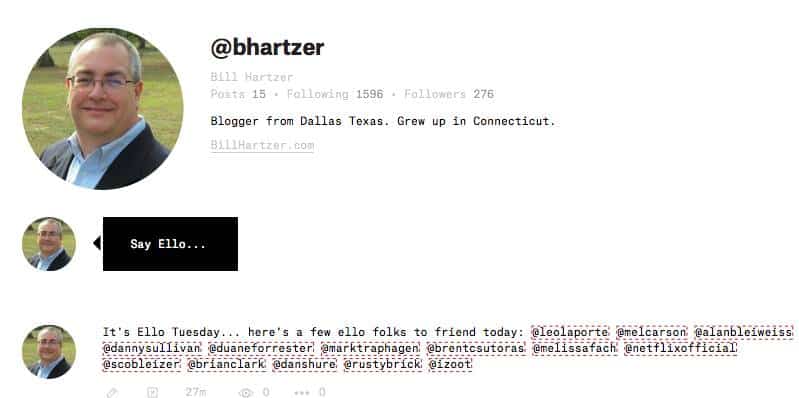
Ello is just like a lot of other social networks. You friend people. You follow people. And you post. Here’s a sample post:


ello post


As you can see, it’s pretty simple: you can post text (even lots of text, and you’re not limited to 140 characters). So feel free to post away. Right now there’s no way to reshare a post: you’ll have to do that manually by copying and pasting someone else’s post.


As for friending people, keep in mind that you can add someone as a friend or ‘noise’. You can see either of those feeds. Think of it as two separate feeds.


If you’re wanting to follow a good number of people, then find someone you trust–someone you know. Then look to see who they’re following and follow those people. Most likely if you know someone, you will know the people who they’re following. For example, here’s the list of people who are following me:


https://ello.co/bhartzer/followers


How to Turn off Ello Notifications

When you follow someone, they typically will get an email notification that you’re following them–unless they’ve turned notifications off. A lot of emails are pretty annoying, so here’s how to turn those off:


Go to your Settings page.

Scroll down to the Notifications area.

Turn off all the notifications, as shown below:


turn off ello notifications


Make sure you fill out your complete profile, including adding a header image and an avatar. Just like on other social media sites, if you still use the default avatar then you just won’t get many followers and it won’t look like you’re serious about using that social network.


You’ll need two separate images:

— A header image (sized 1800 x 1013). Keep in mind that the image will need to be “messed with” a bit, and tested. I added some photos to the image and had to move them down about 100 pixels because they ended up being cut off.

— An avatar. (sized 340 x 340) Most avatar images from other social networks will work, but if you may want to customize this one. It will ultimately be an image that’s in a circle, so keep that in mind.


I’m still testing out Ello, and so far I like it a lot better than some of the other social media networks out there. There are no ads, and if you have a select few people who you want to keep in touch with, then it may just be one that you want to move to. Keep in mind that Ello posts are public if you choose them to be, and there’s a setting for that.


Make sure you follow or “friend” me on Ello, and say “ello”: https://www.ello.co/bhartzer.


The post Introducing Ello, the New Ad-Free Social Network appeared first on Bill Hartzer.


Introducing Ello, the New Ad-Free Social Network